Sussex County, New Jersey
Drywall Repair in Hopatcong, NJ
Water stains, settling cracks, sagging ceilings and holes, rebuilt and textured to match the wall around them, then left ready for paint so the repair doesn't jump out at you.
Next comes a phone conversation with a drywall finisher who works these towns: what's wrong, and what the fix will take.
Call 7 days, 7am–9pm
Check your problem against the common signs.
01Get the damage on record before anyone touches it
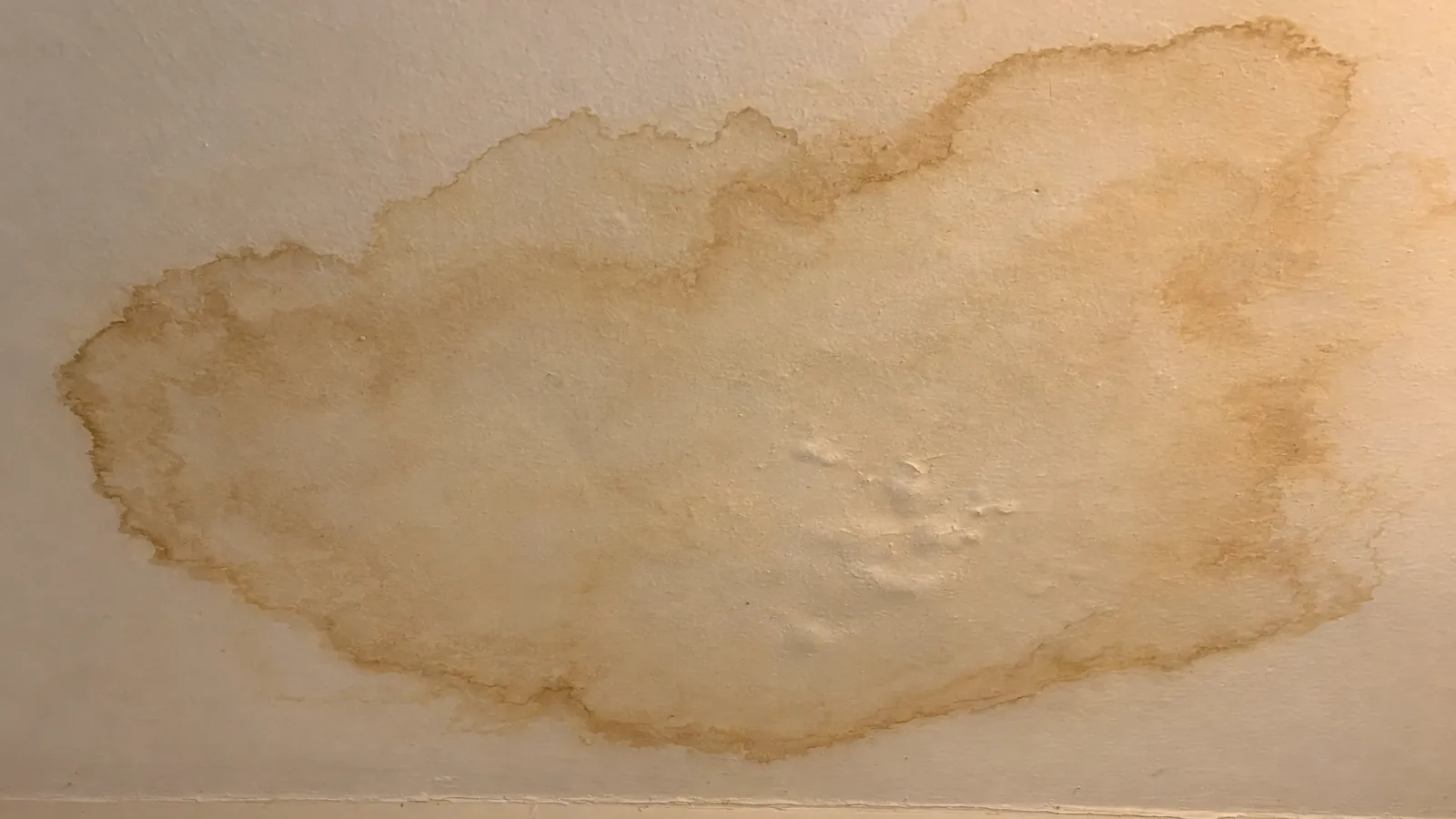
Will your insurer or landlord want proof? Often, yes, so take pictures while the stain, the hole or the sag still looks the way it did when you found it.
Here is what makes a useful record. Photograph the whole wall or ceiling from the doorway, then step in close. Lay a ruler, a credit card or a soda can in one close-up so anyone can judge the scale. If the board is wet, a shot of the darker edge or any drip on the floor shows it was active. Write down the date, the time you noticed it, which room sits above, and whether a tub, toilet, washer or roof valley is nearby.
Keep receipts for anything you buy to stop the water, like a bucket, a tarp or a plumber's call-out. If you rent, send the landlord the photos in writing right away. We can't tell you what a policy covers, and nobody should promise that before the adjuster or landlord has looked. Good notes just shorten that back-and-forth.
02The four repairs, side by side
Not sure which kind of drywall repair you need? Most damage in a house falls into one of four groups, and each group gets a full page of its own.
- Water-Damaged Drywall Repair
Brown rings, softened gypsum and puffy seams from a leak, dried and rebuilt.
- Wall and Ceiling Crack Repair
Seam, corner and settling cracks reinforced with tape instead of filled and hoped over.
- Ceiling Repair
Sags, nail pops, ceiling stains and texture patches overhead.
- Drywall Patching
Doorknob holes, impact damage and openings other trades leave behind.
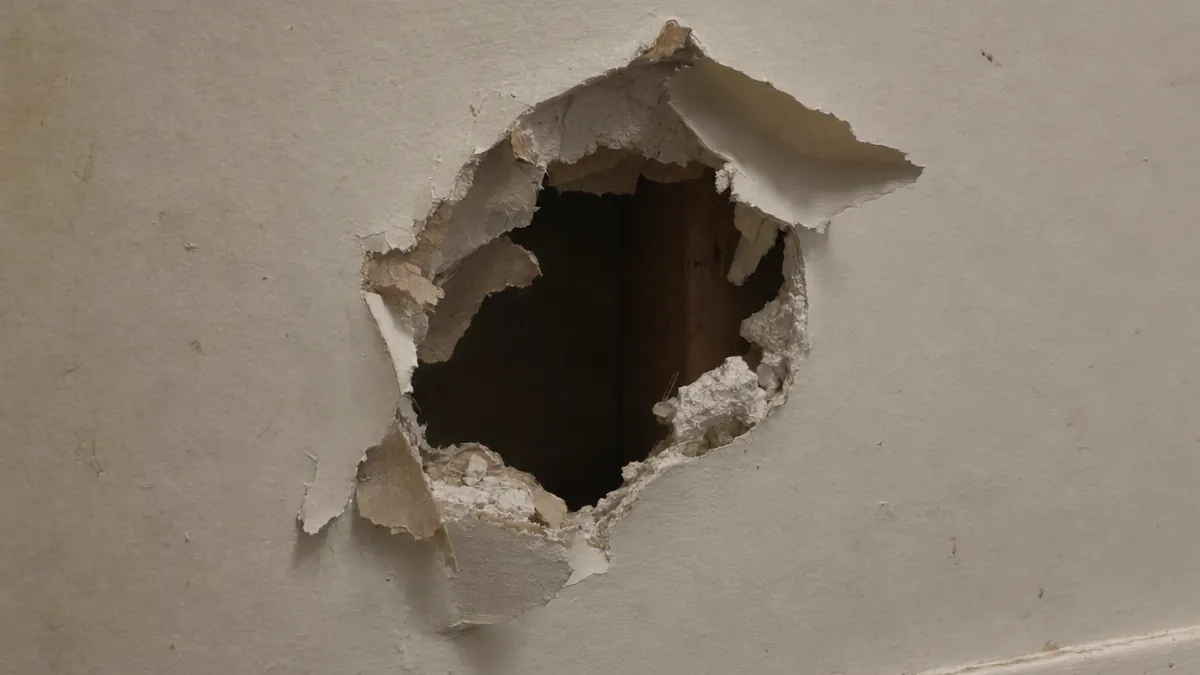
03Closing up after the electrician, plumber or HVAC installer
Did the trade you hired leave a square hole where the new outlet, valve or duct went in? That's normal. Their job ends at the pipe or the wire, so the wall is usually left open.
A proper close-up depends on how the hole was cut. A clean rectangle gets wood backing screwed in behind the edges, a piece of new board cut to fit, then paper or mesh tape over the seams and three thin coats of compound. A ragged opening is squared off first so the new piece sits tight. Bathroom openings near a shower call for moisture-resistant board, and an opening over a new panel or junction box has to leave that box reachable, so ask before anything is sealed over.
Low-voltage installers often leave a row of small holes from fishing cable. Those are filled rather than patched, but they still need the surrounding texture matched or they show as dimples under raking light. Book the repair once every trade is finished in that wall, so the work isn't opened up a second time.
Want the details on board, backing and tape for holes of any size? The drywall patching page walks through it.
04Fist-sized, sheet-sized, room-sized
Does the size of the damage change the job? It changes almost everything: the method, the number of coats, how long the drying takes and whether the room needs paint afterward.
- Small: up to a few inches
Nail holes, anchor holes, a doorknob dent. Filled or covered with a self-adhesive patch, two or three coats, light sanding. Usually one visit plus a return if the compound needs to dry before the last coat.
- Medium: hand to sheet size
A punched hole, a cut-out for a pipe repair, a stretch of torn paper. New board is screwed to backing or framing, taped and coated. New board means coats that need hours to set up between them, which usually stretches the work to a second trip, sometimes a third.
- Large: full sheets or a ceiling bay
Water that traveled, a strip cut out low on a wall after flooding, or a ceiling panel that fell. Whole sheets go up, the joints take several days of coats, and texture is carried well past the repair so its border blends out.
What does it cost? According to Fixr's national cost figures for drywall repair (last updated January 2025), a typical repair runs $200 to $550, a single hole $60 to $200, and a room of water damage $400 to $800. Treat them as national ballparks; they aren't Hopatcong prices. The quote on your wall depends on access, ceiling height, texture and how much of the room needs repainting.
05Houses that started out as summer places
Why is a patch harder in some Hopatcong houses than in a newer subdivision? Because many homes here were not built to be lived in all year.
The borough's own history describes the lake's run as a hotel resort from the 1880s through the Depression, then a bungalow and second-home community after the Second World War. By the mid-1970s, more and more of those homes had become year-round residences, and Wikipedia credits the construction of Interstate 80 with turning Hopatcong into a permanent residential community.
So what does that mean for your walls? A bungalow that was finished out room by room can have framing that is out of plumb, studs that aren't on even spacing, and two or three generations of wall material in one house: original plaster or wallboard in one room, later drywall in an addition. Uneven framing makes patches harder, plainly: the new board has to be shimmed to meet the old surface, and a wide skim coat is often needed to hide the change in plane.
Older paint layers deserve care, too. If sanding is planned on walls that have been painted many times over many decades, ask the pro whether the old paint should be tested first and what keeps the sanding dust inside that room.
06Match the mark on the wall to what caused it
What is that thing on your wall, and is it serious? Here is how the common signs usually line up with their causes.
- Yellow or brown ring
Water has soaked through from above or behind and dried, leaving minerals at the edge. Check whether it is still damp before anything else. See water-damaged drywall repair.
- Ceiling dipping or soft
Soaked gypsum going limp, or screws whose heads have torn through the paper. Treat a fresh sag as urgent. The ceiling repair page covers what to do first.
- Diagonal crack off a door or window corner
The framing has moved a little, often as the house settles or as seasons swing between damp and dry. Usually cosmetic, but it reopens unless it's taped. More on crack repair.
- Little domes along a straight line
Nail pops. Framing keeps drying for its first few heating seasons, and as the wood shrinks the nails creep outward and lift the finish. The fix drives each nail home, adds a screw an inch or so away, and coats the spots.
- Bubbled or peeling paint
Moisture under the paint film, or a patch that was painted before the compound was dry or primed. Find the moisture source first.
- A hole or dent
Impact damage, a door with no stop, furniture moving. Size decides the method; see patching holes and dents.
07Five minutes of homework that make the quote clearer
What should you have in hand when you call? A few photos and a couple of measurements let the pro size up the job over the phone before setting a time.
- Two pictures: the entire wall or ceiling from the doorway, and one up close, in daylight if you can.
- About how big the damaged area is, plus how tall the room's ceiling runs.
- If a light or fan sits in a wet or sagging ceiling, the breaker for that circuit switched off first, and the room underneath cleared.
- Whether the spot is dry, damp or still dripping, and whether the water is shut off.
- Whether you have leftover paint for that wall, and the texture: smooth, orange peel, knockdown or popcorn.
No photos? That's fine. A description over the phone works too. When texting is easier, text us the snapshot at the same number and say which town you're in.
08Hopatcong and the towns on its borders
Is your house outside the borough line? We book repairs in Hopatcong, in all six municipalities sharing its boundary, and in Netcong beside Stanhope.
Hopatcong itself is a Sussex County borough, home to 14,362 people in the 2020 federal count. To the north is Sparta, to the west Byram, and Stanhope sits to the southwest. Over in Morris County sit Mount Arlington, on the lake's southeast shore, Roxbury to the south and Jefferson to the east.
Where we work, town by town, has a sentence or two about each place.
09Northwood, River Styx and Bertrand Island
Does the part of town you live in say anything about your walls? A little, because Hopatcong grew in pieces.
- Northwood and Byram Cove
Both were still in Byram Township until 1922, when residents voted to join Hopatcong. The borough's history notes Northwood as a summer stop for vaudeville performers. A house in a section with a long seasonal past is worth checking for additions built at different times, where walls of two ages meet.
- River Styx
The borough's history describes the River Styx area as busy with bars and miniature golf in the late 1940s and 1950s, the postwar summer crowd. Homes that went from seasonal to year-round use often had heat and insulation added later, and the ceilings under those changes are where stains and cracks tend to start.
- Bertrand Island
The Lake Hopatcong Yacht Club's colonial clubhouse there opened in 1910 and still stands, and the amusement park ran until 1983. For older houses around it, expect plaster or early board that needs a different repair from modern drywall.
10How a repair day usually unfolds
What actually happens on the day? Here is the order a proper drywall repair follows, so you can plan around it.
- The room is cleared and covered. Furniture comes away from the wall, and floors get drop cloths. Ask whether plastic sheeting or a zipper door will be used if the room connects to a hallway or vents.
- The damage is opened up or prepped. Loose paper is cut back, wet board is removed to solid material, and a crack is opened slightly so tape can bed into it.
- Backing, board and tape go in. New pieces are screwed to framing or wood backing, and seams are taped.
- Coats go on, with drying between them. Three thin coats is typical, every one reaching farther out than the one under it. Setting-type compound can speed things up on bigger repairs.
- Sanding, texture and primer. The area is sanded flat, texture is matched, and primer seals the new compound so paint takes evenly.
- The room is put back. Drop cloths come up and dust is vacuumed. Settle early whether painting is in the price or the repair stops at primer.
11Dust, drying and the second coat
What should you honestly expect? Some dust, some waiting, and a wall that looks right once it's painted, though not always on day one.
How much dust to plan for
Sanding makes fine dust even with good habits. Sanding sponges, vacuum sanders and plastic sheeting keep it down. Close the HVAC registers in that room if you can.
Drying
Joint compound dries more slowly in a cold, damp room. A patch that would be ready the next morning in July may need longer in a basement in February. Running the heat helps.
Visits
Small repairs can be finished in one trip with fast-setting compound. Anything with new board usually needs a return for the final coat and texture.
The look
Fresh primer reads brighter than aged paint, and dabbing paint on just the repaired spot often leaves it flatter or glossier than its surroundings. That's why repainting the whole wall, corner to corner, usually gives the cleanest result, and it's worth deciding before the price is agreed (the page on how a job is booked covers the rest). The advice piece on hiding a patch under paint explains why.
12Put a date on that repair
Phone with a description of the wall or ceiling, or put it in the booking form. A finisher who works around the lake talks it over with you and quotes it before a single screw is turned; after that, the repair is finished, textured and left paint-ready.
You'll talk it over with a repair pro from around here, who prices the work before any board is opened.